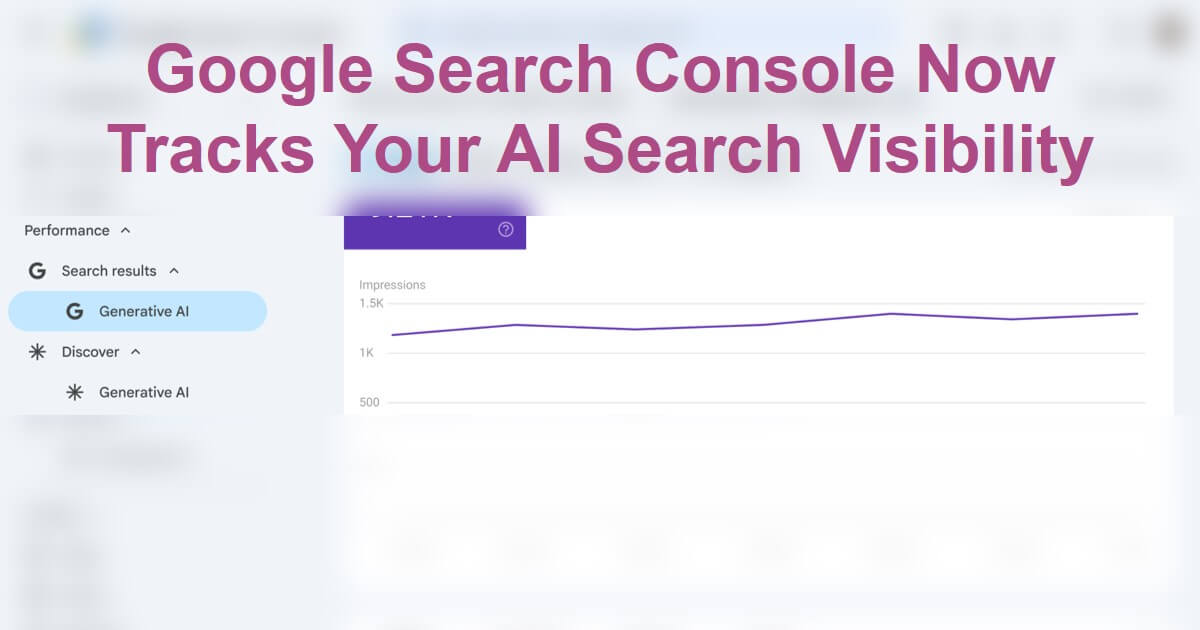
If you have been trying to measure how your website performs inside Google’s AI-generated answers, you have been flying mostly blind — until now. On June 3, 2026, Google officially launched dedicated Generative AI performance reports inside Google Search Console, giving site owners, SEOs, and digital marketers their first structured view of AI search visibility.
This is one of the most significant Search Console updates in years, and understanding it could directly influence your content strategy, your reporting, and how you think about organic traffic in the age of AI search.
What Is the Google Search Console AI Performance Report?
The new Search Console AI performance report is a standalone reporting view that isolates how often your pages appear inside Google’s generative AI features — specifically AI Overviews and AI Mode — as opposed to traditional blue-link results. Google has also launched a parallel report covering generative AI features within Discover.
Previously, impressions from AI Overviews were folded into the main ‘Web’ performance tab, making it nearly impossible to distinguish AI-driven visibility from standard search. The new report separates the two, giving you a dedicated lens.
Metrics Available in the Report
- Impressions — how often your URLs appeared within AI features on Search and Discover
- Pages — which specific URLs are being surfaced inside AI-generated results
- Countries — geographic breakdown of your AI search visibility
- Devices — desktop vs. mobile view (available for Search results)
- Dates — hourly, daily, weekly, and monthly granularity to track trends over time
One important limitation to note upfront: the report currently shows impressions only. There is no click data, no CTR, and no query-level data yet. Google has indicated more metrics will be added over time.
Why This Matters for Your Generative AI SEO Strategy
Tracking AI search visibility has been a gap that every SEO professional has felt since AI Overviews started reshaping Google’s results page at scale in 2024. High impressions with flat or declining clicks became a common pattern — but without a way to isolate AI-driven impressions, diagnosing the cause was guesswork.
With this report, you can finally answer questions like: Which pages are being cited in AI answers? Is my AI visibility growing month over month? Which countries show high AI impressions for my content? Are mobile or desktop users more likely to see my brand in AI results?
For real estate platforms like brocr.in, where content targets specific buyer, seller, and broker queries, this creates an opportunity to identify which blog posts or property pages are already being cited in AI Overviews — and double down on producing content in that format.
Rollout Status and the AI Content Blocking Control
Google is rolling out the new reports to a subset of websites first — currently beginning with UK-based site owners — before a global expansion. There is no confirmed timeline for full availability, so if you do not see the report in your Search Console yet, it has not reached your property.
Alongside the performance report, Google is also testing a toggle that lets site owners block their content from appearing in AI Overviews and AI Mode. This control is similarly in limited beta, and Google has stated it will take effect from June 17, 2026 for the initial test group.
How to Use the Report to Improve Your Content
Once the report is available in your Search Console, here is a practical workflow to get value from it:
- Identify high-impression pages in AI features and audit what makes them AI-friendly — typically clear structure, direct answers, and authoritative depth.
- Compare AI impressions vs. standard impressions to understand whether your organic traffic gap is being caused by AI answer displacement.
- Monitor country-level data to spot where AI search is growing fastest for your target audience.
- Use the date dimension to correlate AI impression changes with content updates or Google algorithm changes.
Making Your Content LLM-Ready: The Bigger Picture
The launch of this report signals that Google is formalizing AI search as its own measurable surface — separate from traditional search. For SEO practitioners, this means content strategy must now account for two parallel goals: ranking in blue-link results and being cited in AI-generated answers.
Content that performs well in AI Overviews tends to be structured, specific, and factual. It answers questions directly, uses clear headings, and cites verifiable data. These are also the hallmarks of content that large language models find easy to parse and retrieve — making LLM-friendly writing a natural extension of good SEO practice.
Key Takeaway
Google’s new Generative AI performance reports in Search Console are not just a new tab — they represent a structural shift in how site owners will measure and optimize for search. The measurement gap for AI search is half-closed. The clicks question remains open, but the visibility question now has an answer. If the report reaches your property, treat it as a priority signal and build your content roadmap around what it reveals.
FAQs about AI Search Visibility in GSC
Q1. What is the Google Search Console AI performance report?
It is a new dedicated report inside Google Search Console, launched on June 3, 2026, that shows how often your web pages appear within Google’s generative AI features — including AI Overviews and AI Mode in Search, and generative AI features in Discover. It gives site owners a separate view from the standard Performance report.
Q2. Does the AI performance report show clicks and CTR?
No. Currently the report shows impressions data only. There is no click data, click-through rate (CTR), average position, or query-level breakdown available at this time. Google has confirmed it is working on expanding the metrics available, but there is no confirmed release date for click data.
Q3. Who can access the new AI performance reports in Search Console?
The reports are currently rolling out to a subset of website owners, starting with sites in the United Kingdom. A broader global rollout is planned, but Google has not provided a specific timeline. If you do not see the report in your Search Console account yet, it has not reached your property.
Q4. What is the AI content blocking toggle mentioned alongside this report?
Google is simultaneously testing a control that allows site owners to block their content from appearing in AI Overviews and AI Mode. This toggle is also in limited beta for a subset of UK site owners, and Google has stated it will take effect from June 17, 2026 for the initial test group. It is separate from the performance report itself.
Q5. How is AI search visibility different from regular Search Console impressions?
Previously, impressions generated by AI Overviews were bundled into the main ‘Web’ search type in the standard Performance report, making it impossible to isolate AI-specific visibility. The new report separates these, so you can see exactly how much of your impression data is coming from generative AI features versus traditional blue-link search results.
Q6. How should I optimise my content to appear in AI Overviews?
Content that performs well in AI Overviews tends to be structured, specific, and factual. Focus on answering user questions directly and concisely, use clear heading hierarchies, include accurate data and citations, and ensure your content demonstrates genuine expertise and authority on the topic. These practices also align with LLM-friendly content writing, making your pages easier for AI systems to parse and cite.